Every student transportation provider has safety policies. There are training manuals, checklists, procedures, inspections, and regulations that define how an operation should run. But a strong safety culture goes beyond what is written down.
It shows up in how drivers are hired and trained, how supervisors respond when something goes wrong, how vehicles are maintained, what behaviors get recognized, and whether employees feel comfortable speaking up when they see a potential problem. Most importantly, it shows up in the decisions people make every day, even when no one is watching.
For school district transportation directors evaluating their own operation or a contracted provider, the question isn’t simply whether safety policies exist. The bigger question is whether those policies have become part of how the organization operates. Here are some signs to look for.
It starts before a driver gets behind the wheel
A strong safety culture begins with hiring and onboarding.
Driving a school bus or van requires technical skill, but transporting students also requires patience, sound judgment, dependability, and an understanding of the responsibility that comes with the job.
Initial training should prepare drivers for more than passing a test. New drivers need to understand expectations around safe driving, student management, emergency procedures, inspections, communication, and the everyday situations they are likely to encounter on their routes.
That foundational preparation is important because once a driver begins transporting students, good judgment often has to happen in real time.
“A culture of safety isn’t what’s written in a manual,” said Scott Heisey, Director of Safety and Compliance at Krise Transportation. “It’s what our drivers, technicians and supervisors do every day when no one is checking because we are not just training people to drive a bus. We are preparing them to be responsible for someone’s child and that’s a big job. We need to know they have the judgment, patience, and sense of responsibility that comes with being in that seat.”
For transportation directors, hiring and onboarding practices can provide an early window into a provider’s safety culture. Ask what happens before a new driver is cleared to transport students, who makes that determination, and how the organization evaluates whether someone is truly ready for the responsibility.
Training has to reflect the students being transported
There isn’t a one-size-fits-all approach to student transportation safety. Training should prepare drivers and aides for the students they will actually serve.
Our partners at Assisted Student Transportation primarily provide alternative transportation for students with special needs, as well as students eligible for transportation through McKinney-Vento and Foster Care programs. That requires additional preparation and a high level of consistency and care.
Assisted drivers receive classroom and field training before beginning service, working with an experienced trainer who evaluates their performance throughout the process. Training includes areas such as passenger assistance and securement, CPR and First Aid, defensive driving, student behavior, incident reporting, and transporting students with special needs.
The larger principle applies to every transportation operation: good safety training isn’t simply about meeting minimum requirements. It prepares people for the specific responsibilities they will face when students are in their care.
Transportation directors should look at whether a provider’s training reflects the actual students, routes, vehicles, and circumstances involved in the contract. A strong safety culture recognizes that compliance establishes a baseline, but preparation has to go deeper.

Training continues after onboarding
Driver training shouldn’t end once someone earns the necessary licenses and certifications. Road conditions change. Technology changes. Regulations change. Drivers encounter new situations with students and families. Even experienced drivers benefit from refreshers and opportunities to sharpen their skills.
Ongoing training can cover defensive driving, emergency response, distracted driving prevention, student behavior management, regulatory requirements, and lessons learned from incidents or close calls.
Regular training also sends an important message to employees: safety is something the organization continues to invest in throughout their career.
For transportation directors, ongoing training is another indicator to watch. How frequently are drivers receiving additional training? What determines the topics? Are lessons from incidents and emerging risks incorporated? A strong safety culture treats training as a continuous process rather than something employees complete during onboarding and rarely revisit.
Mistakes and incidents become opportunities to improve
Even well-run transportation operations will experience difficult situations. What happens afterward can tell you a great deal about the organization’s safety culture.
Incidents should be reported, investigated, and understood. The goal should be to determine what happened, why it happened, and what can be done to reduce the likelihood of it happening again.
Sometimes that leads to additional coaching for a driver. Other times, an incident may reveal a larger issue involving a process, route, vehicle, training program, or communication protocol.
Technology can provide another layer of insight. Krise is currently piloting AI-enabled safety cameras at two of their terminals to evaluate whether the technology can help identify driving behaviors such as distraction, speeding, harsh braking, or following distance. Having better information on a proactive basis gives safety teams an opportunity to identify patterns and provide targeted coaching before a behavior contributes to a more serious incident.
Employees also need to know they can report concerns and close calls before they become serious incidents. A positive safety culture is one where people are not afraid to report concerns so that minor problems don’t become much larger ones.
For transportation directors, pay attention to how a provider talks about incidents. Do they track and investigate all incidents, regardless of severity? Are they focused only on assigning blame, or do they investigate root causes, coach employees, identify patterns, and make changes when needed? A strong safety culture doesn’t hide mistakes. It learns from them.
Safe driving gets noticed, too
Accountability is an important part of safety, but a healthy safety culture shouldn’t focus exclusively on what drivers do wrong.
The same technology Krise is piloting to identify opportunities for coaching can also help safety teams recognize positive driving behaviors. A driver who consistently maintains a safe following distance, handles a difficult situation exceptionally well, or demonstrates other safe habits behind the wheel deserves to have those behaviors noticed.
Technology is only one way to do that. Organizations should regularly recognize drivers who complete inspections thoroughly, follow procedures, communicate concerns, demonstrate safe habits, and set a positive example for their peers. Recognition reinforces what the organization values and gives other employees positive behaviors to model.
Assisted Student Transportation, for example, holds a competition between their terminals and selects a Safety ACE (Achievement in Compliance & Excellence) award winner each semester.
Krise’s safety philosophy is also reflected in their HEROES acronym: Here, Every day, Ready, On-time, Exceptional, Safe. It reinforces the connection between reliability, professionalism, and safety in creating a dependable transportation experience for students.
For transportation directors, recognition programs may seem like a small detail, but they can reveal a great deal about culture. Look for providers that don’t simply correct unsafe behavior, but consistently reinforce and celebrate the behaviors they want repeated.
Safety includes the vehicle
The safest driver in the world still needs a safe vehicle.
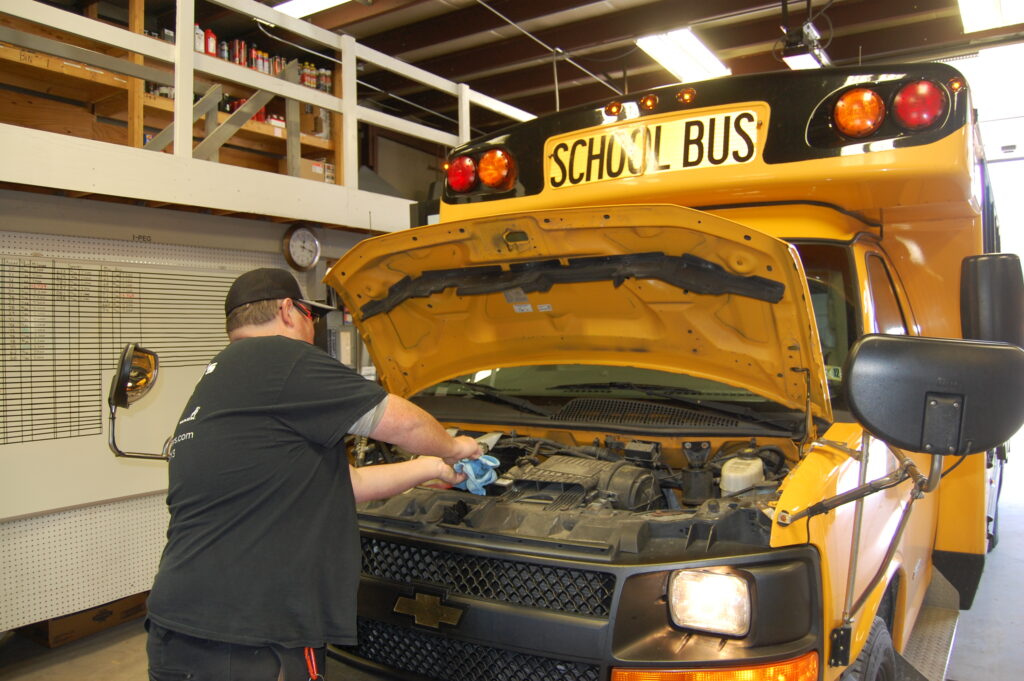
Preventive maintenance, regular inspections, timely repairs, and careful monitoring of safety-critical components all play a role in preventing problems before a bus leaves the lot. Brakes, tires, electrical systems, steering and suspension, emergency equipment, and other critical components need consistent attention throughout the life of a vehicle.
Drivers are an important part of that system. Thorough pre-trip and post-trip inspections can identify concerns before they become larger problems, but only if there is a clear process for reporting those concerns and making sure they are addressed. When drivers, technicians, operations teams, and safety leaders communicate well, vehicle safety becomes a shared responsibility.
Technology is also making it possible to move beyond traditional preventive maintenance toward predictive maintenance. Telematics, onboard diagnostics, and other monitoring systems can provide information about vehicle health and help maintenance teams identify developing problems before a component fails. Instead of waiting for a warning light, breakdown, or scheduled inspection to reveal an issue, maintenance teams can use vehicle data to anticipate when certain components may need attention or replacement.
For school district transportation directors, vehicle maintenance should be part of the safety conversation both when selecting a transportation provider and throughout the life of the contract. During the RFP process, ask potential partners about preventive and predictive maintenance practices, inspection schedules, maintenance documentation, fleet monitoring technology, and how quickly identified issues are addressed. Once the contract is underway, those same areas should remain part of ongoing performance reviews.
A strong safety culture doesn’t separate the people operating the vehicles from the people maintaining them. Districts should have confidence that every vehicle arriving to transport their students is being inspected, monitored, maintained, and repaired with the same attention to safety expected from the person driving it.
Leadership should set the tone
Ultimately, safety culture is shaped by what leaders consistently prioritize.
If leaders talk about safety but overlook problems when schedules are tight, employees notice. If concerns are raised but never addressed, employees notice that too. Over time, those everyday decisions tell employees much more about an organization’s priorities than any safety statement hanging on the wall.
Strong safety leadership means setting clear expectations, providing the training and resources employees need, holding people accountable when standards aren’t met, and being willing to examine the organization’s own processes when something goes wrong.
It also means listening to the people closest to the work. Drivers, aides, trainers, dispatchers, technicians, and local operations teams often see potential risks long before they appear on a performance report.
“You can tell a lot about a safety culture by how quickly someone raises a concern and how quickly it gets addressed,” said Scott Hesiey. “Our drivers, monitors, technicians, and dispatchers see things long before they show up on a report. So, if people feel comfortable speaking up, and we address it quickly, then we are on the right track.”
For transportation directors, leadership may be one of the hardest parts of safety culture to measure in an RFP, but it becomes much easier to see during a working relationship. Pay attention to how quickly concerns are addressed, whether local leaders communicate openly, whether problems are escalated appropriately, and whether commitments around safety continue after the contract has been signed.
Safety is built one day at a time
Policies, procedures, technology, and training all play an important role in student transportation safety. But none of them create a safety culture by itself.
Culture is built through thousands of everyday decisions: a driver taking the time to complete a thorough pre-trip inspection, an aide making sure a student is properly secured, a trainer providing additional coaching, a technician flagging a developing maintenance issue, a supervisor following up on a concern, or a leader recognizing an employee for doing things the right way.
Across the ASTP network, our partners serve different communities, operate different types of vehicles, and transport students with a wide range of needs. But the responsibility is the same: creating an environment where safe decisions are expected, supported, recognized, and continually improved.
For school district transportation directors, that is ultimately what to look for. Don’t evaluate safety culture only by the policies a provider puts in an RFP. Look at how they hire, train, coach, recognize, maintain, communicate, and respond when something doesn’t go according to plan. Those everyday practices provide a much clearer picture of whether safety is simply something an organization promises or something its people live every day.
Contact Us
American Student Transportation Partners is a national network of trusted transportation operators ensuring access to education through safe, reliable student transportation programs. Exceptional bus operators choose ASTP because of our innovative approach to partnership, as well as the resources we provide to help “future-proof” their operations.
Contact ASTP today to learn how we can support your school district’s transportation needs.